Eating More Fibre
Tips to increase the amount of fibre in your diet
Fibre is an important part of a healthy diet. It supports regular bowel movements and can help manage heart disease, diabetes, and digestive conditions. [1,4]
What is dietary fibre?
Dietary fibre is found in all plant foods; it is the part of the plant your body cannot digest. There are two types: insoluble and soluble. Most plant foods contain a mix of both. Your doctor or dietitian may recommend increasing one specific type. If you have not received specific advice, aim to eat both types every day.[1]
Insoluble fibre
Insoluble fibre absorbs water like a sponge, adding bulk to stool and making it softer and easier to pass.[5]
Benefits
- Prevents constipation and haemorrhoids
- Reduces flare-ups of diverticular disease
- Creates a feeling of fullness, which can help with weight management
Good sources
- Wheat bran and wheat germ
- Whole grains: wheat, rye, barley
- Whole grain breads and bran cereals
- Brown rice
- Vegetables: asparagus, beets, broccoli, Brussels sprouts, cabbage, carrots, cauliflower, corn, peas, squash, turnip
- Fruits: apples and pears with skin, apricots, bananas, all berries, citrus fruits, prunes
- Nuts
Soluble fibre
Soluble fibre dissolves in water to form a gel, which slows digestion and helps absorb nutrients more steadily. [4,5]
Benefits
- Thickens stools to reduce diarrhoea
- Lowers blood cholesterol when combined with a healthy, low-fat diet [4]
- Slows stomach emptying, giving more stable blood sugar levels
Good sources
- Dried or canned legumes: kidney beans, chickpeas, lentils
- Oats, oat bran, barley, ground flaxseed, psyllium
- Fruits: apples, apricots, bananas, citrus, pears, prunes, strawberries
- Vegetables: artichoke, broccoli, Brussels sprouts, carrots, corn, squash
- Fibre supplements: Metamucil or Benefibre
How to increase fibre intake
Grains and Flour
- Choose breakfast cereals or breads with at least 4 grams of fibre per serving. Mix in a high-fibre cereal if yours is below 2 grams.
- Add 1-2 tablespoons of wheat bran, wheat germ, or ground flaxseed to yogurt, cereal, or baked goods.
- Replace half the white flour in recipes with whole wheat flour (e.g. 3/4 cup of each for a recipe calling for 1.5 cups plain flour).
- Choose whole grain breads, cereals, pastas, and brown rice.
- Try whole wheat couscous, barley, bulgur, quinoa, or kasha in soups, salads, and casseroles.
Vegetables and Fruit
- Include 1-2 servings of vegetables and fruit at each meal and snack.
- Eat whole fruit and vegetables rather than juice. Pair vegetables with hummus for extra fibre.
- Leave the skin on when possible.
- Add dried fruit to cereals or baked goods.
Legumes, Nuts and Seeds
- Use lentils, beans, and peas as a meat substitute in salads, soups, and casseroles.
- Add nuts and seeds to salads, cereals, and yogurt, or eat as a snack.
- Steamed edamame makes a great high-fibre snack.
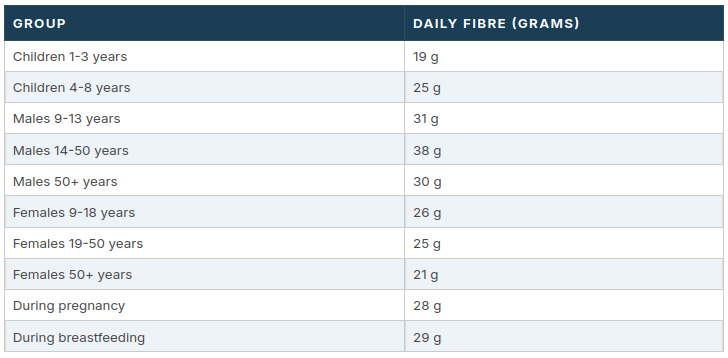
How much fibre do I need each day?
Recommended daily fibre intakes for Australians: [1,2]
Reading food labels
Under Food Standards Australia New Zealand (FSANZ) labelling rules:[3]
- "Source of dietary fibre" - at least 2 grams of fibre per serving
- "Good source of dietary fibre" - at least 4 grams of fibre per serving
- "High in dietary fibre" or "Excellent source of dietary fibre" - at least 7 grams of fibre per serving
Caution
The words "whole grain", "whole wheat", "multigrain", and "organic" do not always mean high fibre. Always check the Nutrition Information Panel.
Important
Adding too much fibre too quickly, or without enough fluids, can cause gas, bloating, cramping, diarrhoea, or constipation. Add one new high-fibre food per day for a week, and drink 8-10 cups of fluid daily.
Simple high-fibre recipe
Bran Apple Blend (makes 17 servings of 2 tablespoons)
3/4 cup applesauce | 3/4 cup All-Bran Original cereal | 1/2 cup prune juice Mix all ingredients together. Refrigerate. Use as a spread on toast, stir into hot cereal or yogurt, or eat by the spoonful. 1 serving = 2 tablespoons = 3 grams of dietary fibre
Resources and support
- Eat for Health (NHMRC): www.eatforhealth.gov.au - Australian Dietary Guidelines and food serving recommendations
- Dietitians Australia: www.dietitiansaustralia.org.au - Find an Accredited Practising Dietitian
- Bowel Cancer Australia: 1800 555 494 | www.bowelcanceraustralia.org - Bowel health resources and diet information
References
1.National Health and Medical Research Council (NHMRC). (2013). Australian Dietary Guidelines. Canberra: NHMRC.https://www.eatforhealth.gov.au
2.Eat for Health (NHMRC). (2023). Australian Guide to Healthy Eating.https://www.eatforhealth.gov.au
3.Food Standards Australia New Zealand (FSANZ). (2024). Nutrient content claims - dietary fibre.https://www.foodstandards.gov.au
4.Reynolds A, et al. (2019). Carbohydrate quality and human health: a series of systematic reviews and meta-analyses. The Lancet, 393(10170), 434-445.
5.Slavin JL. (2005). Dietary fiber and body weight. Nutrition, 21(3), 411-418.
About the author
Dr Krishan Pratap is a Brisbane gastroenterologist and hepatologist with subspecialty expertise in inflammatory bowel disease. He completed an Advanced IBD Fellowship at McMaster University Hospital in Canada and has clinical experience in gastroenterology, hepatology, endoscopy and intestinal ultrasound.
You can reach out to his practice on 07 3063 1273 or submit a referral or new patient form on the referral page and his practice will reach out to you.