Low Fermentable Carbohydrate Diet
Also known as the Low-FODMAP Diet
This diet is recommended for people who regularly experience gas, belching, bloating, abdominal cramping or pain, and diarrhoea and/or constipation. Certain carbohydrates (sugars) that are poorly absorbed draw water into the bowel and are rapidly fermented by gut bacteria, producing excess gas and causing these symptoms. Most people see improvement within a few days to weeks; around 3 in 4 people benefit. [1,2,3]
FODMAP stands for: Fermentable Oligosaccharides, Disaccharides, Monosaccharides, and Polyols. These are types of fermentable sugars found in certain foods. |
Which carbohydrates are fermentable?
- Fructose (fruit sugar): found in fruit, vegetables, and honey; also added to many foods as glucose-fructose (high fructose corn syrup). Foods with excess fructose over glucose are most likely to cause symptoms.[5]
- Lactose: the natural sugar in milk and dairy (see the Lactose Intolerance fact sheet).
- Fructans: chains of fructose found in wheat-based foods and some vegetables. Cannot be broken down at all. Listed on labels as inulin or fructo-oligosaccharides.[5]
- Galactans: found in legumes and some vegetables. Also not absorbed.
- Polyols (sugar alcohols): found in some fruits (apples, pears, stone fruits, avocados, dried fruits) and vegetables (mushrooms, sweet corn), and in sugar-free products (names ending in "-ol": sorbitol, mannitol, xylitol, maltitol).[4,5]
Foods to eat and avoid
The following list is based on Monash University FODMAP research.[4]
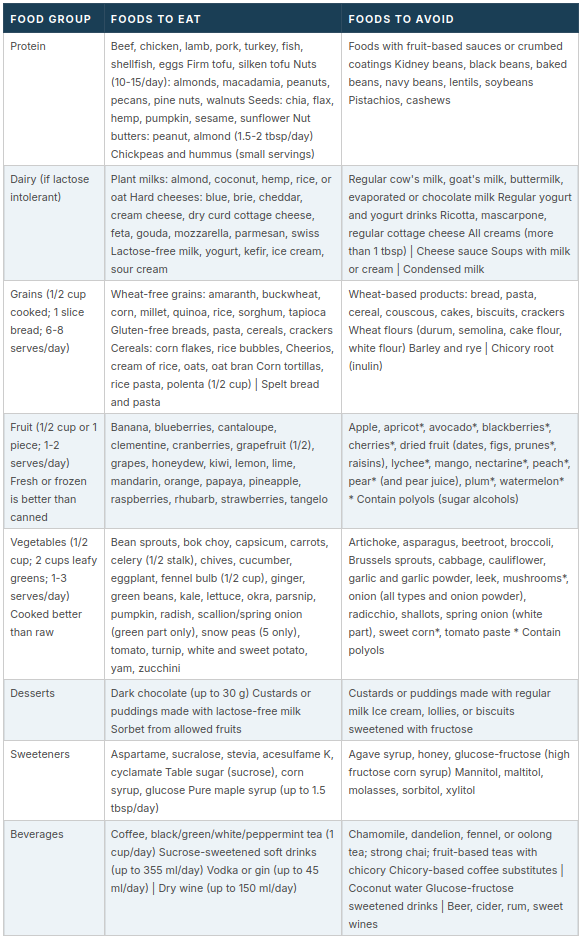
Tips
- Follow the diet for at least 2-3 weeks to see whether it helps your symptoms. Work with an Accredited Practising Dietitian for best results.[3]
- Keep a food and symptom diary to identify your personal trigger foods.
- Read food labels. Avoid: fructose, glucose-fructose, fruit sugar, inulin, fructo-oligosaccharides, honey, wheat, and rye.
- Buy gluten-free breads and pasta; these are wheat-free. You do not need to follow a 100% gluten-free diet; it is the fructans (a carbohydrate) in wheat, not the gluten (a protein), that triggers symptoms.
- Limit even allowed foods to one serving per meal and 1-2 fruit servings per day. This slows fermentation and reduces symptoms.
- Avoid sugar-free products with names ending in "-ol": sorbitol, mannitol, xylitol, maltitol.
- Ask your pharmacist about liquid medications; sorbitol is a common ingredient.
Meal ideas
Breakfast
- Corn flakes or oats with lactose-free milk or almond milk and banana or blueberries
- Smoothie with lactose-free yogurt, lactose-free milk, and strawberries
- Omelette with spinach, capsicum, and cheddar
- Gluten-free toast with peanut butter
- Gluten-free waffles with blueberries and maple syrup
Lunch
- Corn or rice pasta with chicken, tomatoes, capsicum, and herbs
- Gluten-free sandwich with canned salmon or sliced turkey, lettuce, tomato, and mayonnaise
- Green salad with olive oil, lemon dressing, and canned tuna
- Corn tortilla wrap with chicken, lettuce, tomato, olives, and feta
Dinner
- Beef stew with carrots, potato, and celery
- Baked fish with quinoa and carrots
- Stir-fry chicken with bok choy, bean sprouts, and carrots served over brown rice
- Gluten-free pizza with cherry tomatoes, basil, ham, pineapple, and mozzarella
Snacks
- Rice crackers with cheddar or peanut butter
- 1/2 cup pineapple or honeydew, or a small orange
- Small banana with 1 tablespoon peanut butter
- Popcorn
Resources
- Monash University FODMAP Research Group: www.monashfodmap.com - World-leading FODMAP research from Monash University, Melbourne. Free app and certified food list available.
- Dietitians Australia: www.dietitiansaustralia.org.au - Find an Accredited Practising Dietitian experienced with the FODMAP diet
- Irritable Bowel Information and Support Association (IBIS Australia): www.ibisaustralia.org.au - Support and information for people with IBS
- Baker Heart and Diabetes Institute: www.baker.edu.au - Gut health and metabolic research resources
References
1.Gibson PR, Shepherd SJ. (2010). Evidence-based dietary management of functional gastrointestinal symptoms: the FODMAP approach. Journal of Gastroenterology and Hepatology, 25(2), 252-258.
2.Halmos EP, et al. (2014). A diet low in FODMAPs reduces symptoms of irritable bowel syndrome. Gastroenterology, 146(1), 67-75.
3.Staudacher HM, et al. (2012). Comparison of symptom response following advice for a diet low in fermentable carbohydrates (FODMAPs) versus standard dietary advice in patients with IBS. Journal of Human Nutrition and Dietetics, 25(5), 505-512.
4.Monash University. (2024). The low FODMAP diet.https://www.monashfodmap.com
5.Muir JG, et al. (2009). Measurement of short-chain carbohydrates in common Australian vegetables and fruits. Journal of Agricultural and Food Chemistry, 57(2), 554-565.
About the author
Dr Krishan Pratap is a Brisbane gastroenterologist and hepatologist with subspecialty expertise in inflammatory bowel disease. He completed an Advanced IBD Fellowship at McMaster University Hospital in Canada and has clinical experience in gastroenterology, hepatology, endoscopy and intestinal ultrasound.
You can reach out to his practice on 07 3063 1273 or submit a referral or new patient form on the referral page and his practice will reach out to you.