Crohn's Disease
Understanding Crohn's disease, treatment, and living well
Crohn's disease is a long-term inflammatory bowel disease (IBD) that causes inflammation and irritation of any part of the digestive tract. It most commonly affects the end of the small intestine (the ileum) but can occur anywhere from the mouth to the anus.[1,4]
Unlike ulcerative colitis (which affects only the inner lining of the colon), Crohn's disease causes inflammation that goes deep through all layers of the bowel wall. This deeper inflammation leads to more complex complications such as fistulas and strictures. Crohn's disease can also be called ileitis or enteritis.
Who does Crohn's affect?
Crohn's disease affects men and women equally. It most commonly begins between ages 13 and 30. It tends to run in families; many people with Crohn's have a sibling or parent with some form of IBD. Smoking significantly worsens the condition and increases complications.[1,3]
Causes
The cause is unknown, but Crohn's disease is believed to result from an abnormal immune response. Instead of only attacking harmful bacteria, the immune system appears to also attack harmless bacteria and food in the digestive tract, causing ongoing inflammation and tissue damage. Genetic factors, immune dysfunction, and environmental triggers all appear to play a role.[1,4]
Symptoms
The most common symptoms are abdominal pain (often in the lower right area) and diarrhoea. Others include:[1,2]
- Rectal bleeding
- Unintentional weight loss
- Fever
- Fatigue and anaemia (caused by blood loss or poor iron absorption)
Symptoms vary widely from person to person and can range from mild to severe.
Diagnosis
There is no single test for Crohn's disease. A gastroenterologist will use a combination of:[1,4]
- Blood and stool tests: to check for inflammation, anaemia, bleeding, or infection
- Colonoscopy: the most commonly used diagnostic test. A flexible camera examines the entire colon and end of the small intestine. Biopsies are taken for microscopic analysis.
- Flexible sigmoidoscopy: examines only the lower bowel
- MR Enterography (MRE): an MRI-based scan specifically designed to examine the small and large intestine in detail. Patients drink a liquid preparation beforehand to fill and expand the bowel. MRE produces high-resolution images without any radiation and is particularly well suited to Crohn's disease because it can assess the full thickness of the bowel wall, detect active inflammation deep within the small intestine (which cannot be reached by a camera), and identify complications including strictures (narrowings), fistulas, and abscesses. Because it uses no radiation, MRE can be safely repeated over time to monitor disease progression and treatment response. It is available at major hospitals and specialist imaging centres across Australia.[9]
- CT scan: creates detailed 3D images of the bowel and is useful for urgently assessing for complications such as perforation or abscess
- Intestinal ultrasound (IUS): a non-invasive, radiation-free technique that uses sound waves to examine the bowel wall from outside the abdomen. IUS can detect wall thickening, increased blood flow, and other signs of active inflammation. It is increasingly used at specialist IBD centres in Australia as a quick, repeatable way to monitor disease activity and treatment response, without the need for bowel preparation or sedation.[10]
Intestinal Ultrasound and MR Enterography Both MR enterography (MRE) and intestinal ultrasound (IUS) are radiation-free tools that are increasingly used in Crohn's disease management in Australia. MRE is particularly valuable for assessing the small intestine and identifying deep complications, while IUS can be performed during a clinic visit to quickly assess inflammation and monitor treatment response. Ask your gastroenterologist which approach is right for you. |
Complications
Potential complications include:[3,4]
- Bowel obstruction: the bowel wall thickens and narrows from inflammation and scarring
- Fistulas: tunnels from the bowel to other tissues (skin, bladder, vagina) that often become infected
- Anal fissures: small, painful tears in the anal lining
- Nutritional deficiencies: poor absorption leads to low protein, calories, and vitamins
- Anaemia: from blood loss or iron deficiency
- Osteoporosis: particularly in people on long-term corticosteroids
- Joint pain, skin problems, or eye inflammation
- Growth delay in children
Treatment
Treatment aims to control inflammation, relieve symptoms, correct nutritional deficiencies, and maintain remission. There is no cure, but treatment significantly improves quality of life.
Conventional medications
- Corticosteroids (prednisone, budesonide): powerful anti-inflammatories used during flare-ups. Short-term use only due to significant side effects (bone loss, high blood sugar, infection risk).[4]
- Immunosuppressants (azathioprine, 6-mercaptopurine): calm the immune system. Slow-acting (3-6 months). May be combined with other therapies.[4]
- Antibiotics (metronidazole, ciprofloxacin): treat bacterial overgrowth, fistulas, and strictures.
- Anti-diarrhoeal medications and fluid replacement: to manage diarrhoea and prevent dehydration.
Advanced therapies
For people with moderate to severe Crohn's disease that has not responded adequately to conventional treatments, a range of advanced therapies are available in Australia. These include biologic medicines (which target specific proteins involved in inflammation) and small molecule therapies (which are taken orally and work inside immune cells). Your gastroenterologist will recommend the most appropriate option based on your disease location, severity, complications, and other health factors.[4,6,11]
Many of these therapies are available on the Australian Pharmaceutical Benefits Scheme (PBS) for eligible patients with moderate to severe Crohn's disease.[11]
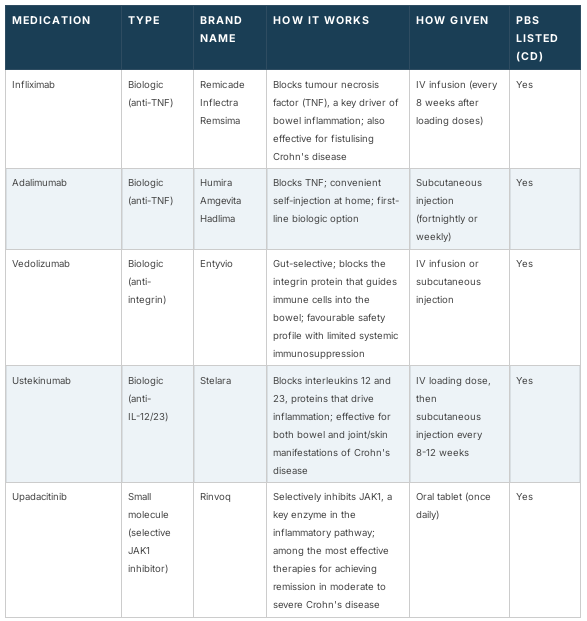
Important note about advanced therapies All advanced therapies carry some risk of side effects, including increased susceptibility to infection. Discuss the benefits and risks of each option carefully with your gastroenterologist. Before starting a biologic or small molecule therapy, you will usually need blood tests, screening for tuberculosis, and up-to-date vaccinations.[4,6] For the most up-to-date information on PBS eligibility, visit www.pbs.gov.au or speak with your gastroenterologist. |
Specific references for advanced therapies:[4,6,7,8]
- Infliximab and adalimumab (anti-TNF biologics): established first-line biologic options with over 20 years of evidence in Crohn's disease, including fistulising disease.
- Vedolizumab (anti-integrin): gut-selective action makes it a preferred option for people with concerns about systemic immune suppression.[6]
- Ustekinumab (anti-IL-12/23): effective and durable response in both luminal Crohn's disease and those with associated arthritis or skin conditions.[7]
- Upadacitinib (selective JAK1 inhibitor): highly effective for both induction and maintenance of remission, with rapid symptom relief.[8]
Surgery
Around 50% of people with Crohn's disease need surgery in the first 10 years after diagnosis:[3]
- Remove a blocked, perforated, or severely diseased section of bowel (intestinal resection)
- Drain abscesses or repair fistulas
Surgery does not cure Crohn's disease; inflammation often returns near the surgical site. Some people need multiple operations over their lifetime. A proctocolectomy with ileostomy (removal of rectum and colon) may be necessary for severe cases. A stoma nurse will provide support and training.
Nutritional support
Nutritional supplements (including liquid formulas) may be recommended, particularly for children with poor growth. Short-term IV nutrition can be used to rest the bowel or supplement nutrition. Calcium, vitamin D, and other supplements may be prescribed, especially for people on corticosteroids.
Diet and lifestyle
- Follow a nutritious, balanced diet; Crohn's reduces appetite and absorption, so adequate nutrition is essential.
- Keep a food diary to identify personal trigger foods (common culprits include spicy foods, high-fibre foods, alcohol, and dairy during flare-ups).
- Stop smoking: it significantly worsens Crohn's disease, increases flare frequency, and increases the need for surgery.[1]
- Manage stress; while stress does not cause Crohn's disease, it may trigger flare-ups. Sleep, exercise, and relaxation techniques can help. Ask your doctor about counselling or support groups.
Pregnancy
Women with Crohn's disease can become pregnant and have healthy pregnancies. Discuss plans with your doctor before conceiving, as some medications may need adjusting. Most children born to women with Crohn's disease are not affected by the condition.[5]
Resources
- Crohn's and Colitis Australia: 1800 138 029 | www.crohnsandcolitis.com.au - Patient support, education, and community for people living with IBD in Australia
- IBD Connect Australia: www.ibdconnect.com.au - Peer support network for IBD patients across Australia
- Ostomy Australia: www.ostomyaustralia.com.au - Support for people living with a stoma following Crohn's-related surgery
- NPS MedicineWise - IBD medicines: www.nps.org.au - Consumer information on biologic and advanced therapies used in IBD
REFERENCES
1.Gastroenterological Society of Australia (GESA). (2023). Crohn's disease position statement.https://www.gesa.org.au
2.Crohn's and Colitis Australia. (2024). Crohn's disease overview.https://www.crohnsandcolitis.com.au
3.Peyrin-Biroulet L, et al. (2010). The natural history of adult Crohn's disease in population-based cohorts. American Journal of Gastroenterology, 105(2), 289-297.
4.Gomollon F, et al. (2017). 3rd European Evidence-Based Consensus on the Diagnosis and Management of Crohn's Disease. Journal of Crohn's and Colitis, 11(1), 3-25.
5.Nguyen GC, et al. (2011). The Toronto consensus statements for the management of IBD in pregnancy. Gastroenterology, 141(2), 451-466.
6.Feuerstein JD, et al. (2021). AGA Clinical Practice Guidelines on the Management of Crohn's Disease in Adults. Gastroenterology, 160(6), 2496-2508.
7.Sandborn WJ, et al. (2020). Efficacy and Safety of Ustekinumab for Crohn's Disease Over 5 Years. Clinical Gastroenterology and Hepatology, 18(7), 1539-1548.
8.Danese S, et al. (2022). Upadacitinib as induction and maintenance therapy for moderately to severely active Crohn's disease. The Lancet, 399(10341), 2113-2128.
9.Rimola J, et al. (2017). MR enterography for assessment of disease activity in Crohn's disease: novel MR-based biomarkers for bowel damage. Journal of Crohn's and Colitis, 11(12), 1470-1477.
10.Allocca M, et al. (2023). Accuracy of intestinal ultrasound in assessing inflammatory bowel disease activity and disease extent. Journal of Crohn's and Colitis, 17(2), 174-185.
11.Australian Pharmaceutical Benefits Scheme (PBS). (2024). Biological medicines for IBD.https://www.pbs.gov.au
About the author
Dr Krishan Pratap is a Brisbane gastroenterologist and hepatologist with subspecialty expertise in inflammatory bowel disease. He completed an Advanced IBD Fellowship at McMaster University Hospital in Canada and has clinical experience in gastroenterology, hepatology, endoscopy and intestinal ultrasound.
You can reach out to his practice on 07 3063 1273 or submit a referral or new patient form on the referral page and his practice will reach out to you.